MICHIGAN CHESS ASSOCIATION

Michigan Chess Online Jan-Feb 2006
Michigan
Jan
Feb
2006
Chess
Online
2005 Michigan Open Reserve
by Jeff Aldrich

Smooth Sailing

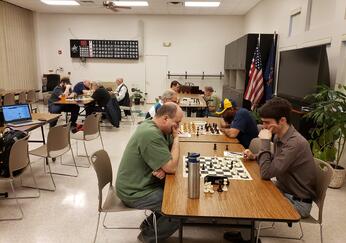
This Reserve section was pretty much within status quo since we added the Booster section. A total of 58 entries came to Flint to compete. The 4-day schedule was once again the most popular with 27 players. Another 21 played in the 3-day schedule. Ten players competed in the 2-day schedule, two of which were re-entries.

Rounds 1-4

Here are some great games from the first four rounds in the section.

Douglas Fick II (1670)
William Morian (1507)
4-day, Round 1
Two Knights: Lange, C55

Notes by Tim McGrew

1.e4 e5 2.Nf3 Nc6 3.Bc4 Bc5 4.0-0 Nf6 5.d4!?

George Koltanowski used to play this way in countless blindfold simul games.

5...exd4

His idea -- still worth exploring today if you’re an ambitious player and don’t collapse at the thought of a pawn sacrifice -- is 5...Bxd4 6.Nxd4 Nxd4 7.f4! when Black has to play very carefully in order to avoid a quick knockout.

6.e5

Now we have transposed into the Max Lange Attack, another Koltanowski specialty.

6...Ng8

This retreat is scarcely mentioned in the theory books. It looks too passive to equalize, but White needs to follow up briskly.

7.Ng5!?

White is eager to strike at f7, which isn’t bad but probably isn’t the very best he can do. 7.Re1 looks like the most principled move, defending e5 and discouraging Black from moving his d-pawn. 7...Nge7? (7...h6 is probably better, but then 8.c3 dxc3 9.Nxc3 gives White a great version of the Goring Gambit.) 8.Ng5! 0-0 9.Qh5!+- would be crushing since Black cannot defend both f7 and h7. This is a pattern of attack worth remembering.

7...Nh6 8.Qh5

If White wants to play this line, the idea should be to fracture Black’s kingside pawns and weaken dark squares, e.g. 8.Ne4 Be7 9.Bxh6 gxh6 10.Qh5±. Black’s position is very uncomfortable.

8...Qe7 9.f4 d6

9...d5! 10.Bxd5 Nb4! seems to transfer the initiative, though in open positions it can be tricky to foresee exactly how things will pan out.

10.e6

A puzzling move for Black to have to meet. Something is going wrong on f7. Can Black find enough play elsewhere to compensate for it?

10...Nd8

Black hunkers down for passive defense, but now White invites someone else to the party and life gets even harder. This is probably the last chance for something like 10...Nb4 11.exf7+ Kf8 12.Na3 d5 when Black is definitely still in the game and may actually stand better, his paralyzed king notwithstanding.

11.Re1

Now the threat is 12.exf7+ winning Black’s queen. 11.f5 right away isn’t bad either.

11...Kf8

This sideways dodge is forced. Fritz thinks Black is just slightly worse here, but anyone who has played tournament chess knows that it is unbelievably hard to keep finding one “only” move after another in such positions.

12.f5!

Now the threat is 13.f6!! when something breaks on the kingside.

12...Nxf5 13.Nxh7+ Kg8

Oh no! He stepped onto a light square! 13...Rxh7 14.Qxh7 fxe6 is miserable for Black, but he isn’t mated yet.

14.exf7+ 1-0


Ashley Carter (1682)
Eugene McClure (1539)
3-day, Round 1
Tarrasch, D32

1.d4 d5 2.c4 e6 3.Nc3 c5 4.cxd5 exd5 5.dxc5 d4 6.Ne4 Bxc5 7.Nxc5 Qa5+ 8.Bd2 Qxc5 9.Rc1 Qf5 10.Qa4+ Nc6 11.Nf3 Qd5 12.g3 Bd7 13.Bg2 Nf6 14.0-0 0-0 15.a3 a6 16.b4 b5 17.Qc2 Rac8 18.Qb2 Rfe8 19.Rfe1 d3 20.Rc5 Qd6 21.Bf4 Qe7 22.Be3 dxe2 23.Rxe2 h6 24.Rcc2 Ne5 25.Bc5 Nxf3+ 26.Bxf3 Qd8 27.Bb7 Rb8 28.Bxa6 Rxe2 29.Rxe2 Bh3 30.Qd2 Qc7 31.f3 Rd8 32.Qe3 Rd1+ 33.Re1 Rxe1+ 34.Qxe1 Qc6 35.g4 Qxf3 36.Bb7 Qxb7 37.Qg3 Bxg4 38.Bd4 Qf3 39.Qb8+ Kh7 40.Qxb5 Bh3 0-1


Ferrel Moore (Unr)
Michael Schroer (1601)
2-day, Round 1
Sicilian: Tartakower, B53

Notes by Tim McGrew

1.e4 c5 2.Nf3 d6 3.d4 cxd4 4.c3?!

Theory says that if White wants to play this Smith-Morra sort of gambit he should do so before Black has got the move ...d6 in.

4...dxc3

Falling in with White’s plans. The right move here is 4...Nf6! White’s weak e-pawn is something of an embarrassment, and after 5.Bd3 dxc3 6.Nxc3. White is virtually a tempo behind the ordinary Smith-Morra since the bishop really belongs on c4, not on d3.

5.Bc4?!

Very risky! White deliberately sacrifices another pawn in order to accelerate his development. 5.Nxc3 would transpose into the main lines of the Smith-Morra.

5...e6

Black is spooked by the specter of pressure against f7, but actually it was quite safe to take the pawn right away.

6.0-0

White is having none of it. 6.Nxc3 is still the ordinary Smith-Morra.

6...cxb2

Finally!

7.Bxb2

Now the game bears a curious resemblance to the Danish Gambit. Unfortunately for White, however, Black has both of his center pawns here. That means he can hunker down and defend without much fear of getting blown out of the water by a sacrifice on (say) f7. Still, if you keep your eyes open you will see that anything can happen (and usually does).

7...Nf6 8.Qe2 Be7 9.Rd1

This is a good idea, putting the rook opposite Black’s queen for tactical reasons.

9...0-0 10.e5

Exploiting the pin on the d-pawn.

10...Ne8 11.exd6 Nxd6

White has what he wanted -- a pinned knight to torment. But his pieces are not optimally placed to cause the knight serious trouble. But perhaps White can take some consolation from the fact that he now has a couple of nice diagonals for his bishops.

12.Nc3

12.Bd3 looks a little more dangerous, immediately targeting the h7-square.

12...Qc7 13.Bd3 a6

This is a bit slow, though Black should still be okay.

14.Rac1

More of that rook-opposite-the-queen stuff. 14.Qc2!? is worth a try here since Black’s queen is undefended. The point is that 14...f5 runs into the tricky shot 15.Nd5!! Qxc2 16.Nxe7+ Kf7 17.Bxc2 Kxe7 18.Rxd6! (Or just 18.Ba3 Rd8 19.Rxd6 Rxd6 20.Rd1+-) 18...Kxd6 19.Ba3++- and Black loses material. Many other 14th moves (g6, h6) are similarly clobbered by 15.Nd5. Check it out for yourself!

14...Nc6 15.Ne4 e5?

A careless thrust. 15...Nxe4 16.Qxe4 f5 would quash White’s kingside ambitions and leave Black very comfortably placed to exploit his material advantage.

White to Move

16.Nxd6?

16.Bxe5! would completely turn the tables. Black’s knights are pinned every which way, and he cannot avoid losing some material. 16...Rd8 17.Nxd6 Bxd6 18.Bxd6 and Black cannot play 18...Rxd6?? because of 19.Qe8#, while 18...Qxd6 allows 19.Bxh7++- winning the queen for not nearly enough.

16...Bxd6 17.Bxh7+?

Oh no! White miscounts the defenders of e5. 17.Be4 still makes something of a fight of it.

17...Kxh7 18.Nxe5 Bxe5 0-1


Paul Kane (1619)
Steve Rosenberg (1731)
4-day, Round 2
Budapest, A51

Notes by Tim McGrew

1.d4 Nf6 2.c4 e5!

Yes, we award punctuation for fighting spirit! I was just recommending this defense to someone at the Michigan Amateur in October.

3.Nc3?!

White immediately steps off of the theoretically approved path and finds himself fighting to show that he has equality. No one should shelve the game at this point as irrelevant: when you play unusual openings with a logical basis, your opponent will often sidestep the main lines either through ignorance or through trepidation. Either way, what happens here is of great practical relevance.

3...exd4 4.Qxd4 Nc6 5.Qd1 Be7

This is very nearly the only move Black makes in this game that I don’t think is strongest. Here 5...Bb4!? is positionally threatening. White will not want to have doubled, isolated c-pawns, but that means he must take a tempo out to do something relatively passive like 6.Bd2 Black’s pieces will all find good squares and White is left with the puzzle of how to develop effectively. Alternatively, 5...Bc5 looks active and sets a small trap: 6.Bg5? Bxf2+ 7.Kxf2 Ng4+ 8.Ke1 Qxg5-+

6.Nf3 d6 7.e3 Bg4 8.Be2 0-0 9.b3 Re8 10.Bb2 Qd7 11.Qc2 Bf5

Somewhere around here, White must have sensed that the game was not under his control. The pawn at c4 is supposed to confer a space advantage, but it seems to be posing no particular difficulties for Black. So White reaches for his bishop to brush away the pesky attack.

12.Bd3??

When I make a move like this, I usually sense what went wrong as my hand leaves the piece. On the other hand, 12.e4 isn’t such a tremendous idea either. Black can either back up with 12...Bg6 and torment the e-pawn or else lash out with 12...Nxe4!? when things get hot on the e-file: 13.Nxe4 Bxe4 14.Qxe4 Bf6! 15.Qb1 (15.Qc2 Nb4 16.Qd2 Bxb2 17.Qxb2?? Nd3+-+ picks up the queen at a bargain price.) 15...Qe6! 16.Ng1 Nd4! 17.Bxd4 Bxd4 and White is losing the trapped rook on a1. A simplistic material count might leave one thinking that this is not so bad, but after 18.Qd1 Qf6! 19.Rb1 Qxf2+ 20.Kd2 Re4!-+ the truth becomes apparent: White’s pieces are badly tangled up and Black’s other rook will join the attack presently.

Black to Move

12...Nb4!

Ouch! That hurts!

13.Qd2

From the standpoint of offering resistance, it would have been better to sacrifice the queen for two minor pieces with 13.Bxf5 Nxc2+ 14.Bxc2 White is, of course, still losing. But he has more pieces on the board than Black does (six to five) and his king is safe for the time being. It is very hard to make a decision like this over the board, but every strong player develops a sense of which lost positions offer even minimal swindle potential and which do not. This is something you cannot learn from Fritz!

13...Nxd3+

From now on Black has a happy choice of natural moves, all of them strong.

14.Ke2 d5 15.Nd4 dxc4 16.Nxf5 Qxf5 17.bxc4 Rad8! 18.Kf1 Bc5 19.Nd1 Ne4! 20.Qe2 Nf4! 21.Qf3 Nd2+

The remainder of the moves are illegible on the scoresheet, but it’s a reasonable guess that the game finished something like this: 22.Ke1 [Or 22.Kg1 Nxf3+ 23.gxf3 Qh3 24.exf4 Re1#] 22...Nxf3+ 23.gxf3 Qd3 24.Nc3 Ng2# (Editor Note: The final moves were confirmed to start with the following illegal move.)

22.Ke2 Nxf3+ 23.gxf3 Qd3+ 24.Ke1 Qe2# 0-1


Antonio Velasquez (1652)
Robert Moore (1600)
4-day, Round 2
Irregular Queen’s Pawn: Kotov, A40

1.d4 g6 2.Nf3 Bg7 3.e3 d6 4.Be2 Nd7 5.0-0 e5 6.c4 Ne7 7.Nc3 0-0 8.b4 c6 9.a4 b6 10.Qb3 exd4 11.exd4 Nf5 12.Rd1 Nf6 13.Rb1 Be6 14.d5 cxd5 15.Nxd5 Nxd5 16.cxd5 Bd7 17.Bf4 Qe8 18.Bb5 Bxb5 19.axb5 Qxb5 20.g4 Rfc8 21.Qd3 Qd7 22.Rbc1 Ne7 23.h3 h5 24.Nh2 hxg4 25.hxg4 a5 26.bxa5 bxa5 27.Rxc8+ Nxc8 28.Qa3 a4 29.f3 Rb8 30.Qd3 Rb3 31.Qa6 a3 32.Bc1 Qa7+ 33.Qxa7 Nxa7 34.Kf2 a2 35.Be3 Rb1 0-1


Joe Beane Jr. (1581)
Ed Mandell (1350)
3-day, Round 2
Irregular King’s Knight: Queen’s Pawn (Maróczy), C40

1.e4 e5 2.Nf3 d5 3.exd5 Bd6 4.Nc3 Nf6 5.Bc4 0-0 6.h3 Re8 7.0-0 e4 8.Nd4 Bc5 9.Nde2 Nbd7 10.Ng3 Nb6 11.Bb5 Re7 12.d3 e3 13.d4 exf2+ 14.Rxf2 Bd6 15.Bf4 Nfxd5 16.Nxd5 Nxd5 17.Bxd6 Qxd6 18.Qf3 c6 19.Bd3 Nb4 20.c3 Nxd3 21.Qxd3 c5 22.d5 Bd7 23.Ne4 Qb6 24.Raf1 c4 25.Qf3 Qg6 26.Nc5 b6 27.d6 Qxd6 28.Qxa8+ Re8 29.Qf3 bxc5 30.Qxf7+ Kh8 31.Qxe8+ 1-0


Douglas Fick II (1670)
Jewell Morris (1765)
3/4-day, Round 3
Caro-Kann: Panov, B14

Notes by Bill Calton

1.e4 d5 2.exd5 Nf6 3.c4 c6 4.d4 cxd5 5.Nc3 e6 6.Nf3 Nc6 7.Bd3

White abandons the fight for the tempo, and accepts the isolated pawn. 7.Bg5 Aagaard considers this the most accurate move, in his Easy Guide to the Panov-Botvinnik Attack (1998). He then analyzes White playing for a bind after 7...Be7 (7...dxc4 or Black can force the isolated pawn game, but with a tempo more for White 8.Bxc4 Be7 9.0-0 0-0 10.a3 a6 11.Ba2 b5 12.Qd3 Bb7 13.Rad1 Aagaard generally prefers White in these type of positions.) 8.c5 0-0 9.Bb5 as slightly better for White (or 9.Rc1!?)

7...dxc4 8.Bxc4 Bb4 9.0-0 0-0 10.Bf4

10.Bg5 would apply more pressure to Black’s position. White is voluntarily renouncing one of his main trumps in this type of position, namely the advance d5 to release the attacking energy inert in White’s position. d5 is unlikely to ever work with the bishop standing on f4.

10...Bxc3?!

Ceding the bishop pair, and healing White’s pawns helps only White. I would prefer developing the light bishop to the long diagonal beginning with either ...b6, or ...a6 with ...b5 to follow.

11.bxc3 Nd5 12.Bxd5?!

12.Bd2 This retreat would protect the c3-point and preserve the powerful dark bishop. Once White retreats the light bishop to the b1-h7 diagonal, White can take aim at Black’s vulnerable kingside.

12...Qxd5 13.Qb3 Qf5 14.Bg3 b6

Strategically, this looks equal now. But tactics weigh more heavily. Observe the players allow three tactical shots form this point forward.

15.Rae1?

Wrong rook.

15...Bb7

#1: 15...Ba6! 16.c4 Na5 with advantage to Black.

16.Ne5 Nxe5 17.Rxe5 Qg6 18.Qb1 Qxb1 19.Rxb1 Rac8 20.Rc1 Rfd8 21.Bf4 Rc4 22.Rc2? Rdxd4!

#2: Clear edge to Black.

23.cxd4 Rxc2 24.a3 Ra2 25.Bc1 Ra1 26.Re1 Bd5 27.f3 Kf8 28.Bd2 Rxa3?? 29.Bb4+! 1-0

#3: Game, set, match.


Bill Hazzard (1575)
Charlie Petlick (1406)
3/4-day, Round 3
Pirc, B07

Notes by Tim McGrew

White is on the way to a convincing win when both sides stumble. But in the end, fortune favors the brave.

1.e4 d6 2.d4 Nf6 3.Nc3 g6 4.h3

This relatively nonstandard move is actually quite reasonable. Play against White’s pawn on d4 is one of the motifs of the Pirc, and since a knight on f3 is a defender of d4, Black often resorts to ...Bg4 to fight for that square. Since Black is taking a relaxed approach to getting his pieces off of the back rank and there is no clash in the center at the moment, White can afford the tempo. Contemporary devotees of 4.h3 include GMs Totsky and Vajda.

4...Bg7 5.Be3 0-0 6.Qd2 e5 7.Nf3

A positionally interesting alternative is 7.dxe5 dxe5 8.0-0-0 when White’s control of the d-file gives him some advantage. This idea is also available next move.

7...c6 8.Bd3 Nbd7 9.Bh6 Nh5 10.Bxg7 Kxg7 11.0-0-0

White decides to turn it into an attacking race.

11...b5 12.Ne2

Partly to get the knight out of the way of the onrushing pawns, partly to increase White’s control over the f4-square to prevent Black’s knight from going there when White hits it next move.

12...a5

Black’s pawns are rushing forward, but there is nothing for them to “bite” on over on the queenside, whereas White has the hook at g6 for his attack.

13.g4 Nhf6 14.Rdg1 b4 15.h4 Nb6 16.h5! Bxg4 17.hxg6! fxg6

17...Bxf3 runs into a mate: 18.Qh6+ Kg8 (18...Kh8 could lead to an unusual three-Rooks mating position, e.g. 19.g7+ Kg8 20.gxf8R#) 19.gxh7+ Kh8 20.Qg7#.

18.Qh6+ Kf7 19.Ng5+

The exchange sacrifice 19.Rxg4 Nxg4 20.Qxh7+ is also very strong.

19...Ke7 20.Qg7+ Ke8

Up to here White has been conducting the attack superbly, but now he falters.

White to Move

21.Rxg4?!

Not bad, but not as crisp as the alternative. 21.Nxh7! Rf7 22.Qxg6 Be6 23.Ng5+- wins without any fuss.

21...Nxg4 22.Rxh7?

This is obviously a bad oversight. 22.Nxh7 Rf7 23.Qxg6 is still winning.

22...Qxg5+ 23.Kb1??

Relatively best was 23.f4 Qf6 (23...exf4 24.e5! and 25.Bxg6+ is +-.) 24.Qc7 Rc8 25.Qxb6 with a messy, murky position.

23...Nf6??

But Black returns the favor. 23...Rd8!

24.Qe7# 1-0


Andrew Waller (1655)
Michael Schroer (1601)
2-day, Round 3
Sicilian: Tartakower, B53

Notes by Tony Palmer

1.e4 c5 2.Nf3 d6 3.d4 cxd4 4.c3

The Smith-Morra Gambit always leads to a lively game.

4...dxc3 5.Nxc3 Nf6

Black does best to play 5...Nc6 first, preventing White from advancing e4-e5 with attacking chances.

6.Bc4 a6

6...Nc6? 7.e5 Nxe5 8.Nxe5 dxe5 9.Bxf7+! 1-0 (DeBolster-NN, KNSB 1970) is a stock trap. Black needs to play ...e6 before developing both knights.

7.0-0 b5 8.Bb3 b4

A common plan against the Sicilian Sozin, yet playing to win the e4-pawn is dubious given Black’s undeveloped state.

9.Na4 Nxe4?!

White wins material.

10.Qd5

10.Bd5 also wins.

10...Nc5 11.Qxf7+ Kd7 12.Nxc5+ Kc7

12...dxc5 13.Rd1+ wins the queen.

13.Ne6+ Bxe6 14.Qxe6

White is a clear piece up.

14...Nc6 15.Be3 h6 16.Rac1 a5 17.Bd5 Ra6 18.Nd4

Piling on the pinned piece to win.

18...Qe8 19.Bxc6 1-0

A good example of White’s attacking potential with the Smith-Morra Gambit.


Justin Aldrich (1762)
Steve Rosenberg (1731)
3/4-day, Round 4
Vienna: Falkbeer (Three Knights), C28

1.e4 Nf6 2.Nc3 e5 3.Bc4 Nc6 4.a3 Be7 5.Nf3 d6 6.h3 0-0 7.d3 h6 8.0-0 a6 9.Nh2 Be6 10.Bxe6 fxe6 11.f4 exf4 12.Bxf4 d5 13.e5 Nd7 14.Qg4 Bc5+ 15.Kh1 Qe7 16.Rae1 g5 17.h4 h5 18.Qxg5+ Qxg5 19.Bxg5 Ndxe5 20.Rf6 Rxf6 21.Bxf6 Bd4 22.Bg5 Rf8 23.Be3 Rf5 24.Kg1 Bxe3+ 25.Rxe3 Nd4 26.Nf3 Ndxf3+ 27.gxf3 d4 28.Rxe5 Rxe5 29.Ne4 Rb5 30.b3 Rb6 31.Nf6+ Kf7 32.Nd7 Rb5 33.f4 Ke7 34.Ne5 Rc5 35.Nc4 b5 36.b4 Rc6 37.Nd2 Rxc2 38.Nb3 Rc3 39.Nxd4 Rxd3 40.Nc6+ Kf6 41.Ne5 Rxa3 42.Nd7+ Ke7 43.Nc5 Rc3 44.Nxa6 Rc6 45.Nc5 Rxc5 46.bxc5 Kd7 47.Kf2 Kc6 48.Ke3 Kxc5 49.Ke4 b4 50.Ke5 b3 51.Kxe6 b2 52.f5 b1Q 53.f6 Qe4+ 54.Kd7 Qxh4 55.f7 Qf6 56.Ke8 Qxf7+ 57.Kxf7 h4 0-1


Jewell Morris (1765)
Jay Carr (1600)
3/4-day, Round 4
Slav, D10

1.d4 d5 2.c4 c6 3.Nc3 Nf6 4.Bf4 Bf5 5.Nf3 h6 6.e3 e6 7.c5 Be7 8.Be2 0-0 9.0 0 Nbd7 10.Ne5 Ne4 11.Nxe4 Bxe4 12.Qb3 Qc8 13.f3 Bh7 14.Bd3 f6 15.Bxh7+ Kxh7 16.Qc2+ f5 17.e4 Nxe5 18.Bxe5 Bf6 19.exf5 exf5 20.f4 g6 21.Rae1 Qd7 22.Bxf6 Rxf6 23.Qe2 Raf8 24.Rf3 R8f7 25.Re3 Kg7 26.Re8 Qc7 27.Qe5 Rd7 28.Rg8+ Kxg8 29.Qxf6 Rg7 30.Re8+ Kh7 31.Qf8 g5 32.Qxf5+ Rg6 33.fxg5 hxg5 34.Qf8 Rg7 35.Qh8+ Kg6 36.Re6+ Kf5 37.Re5+ Kf6 38.Qh6+ Kf7 39.Qe6+ Kf8 40.Qe8# 1-0


John Gattinger (1772)
James Canty Jr. (1690)
2-day, Round 4
Queen’s Gambit Declined, D31

Notes by Tim McGrew

1.d4 e6 2.c4 d5 3.Nc3 Bb4!?

This unusual defense to the Queen’s Gambit was played by Chigorin and turned into a coherent system by Ragozin. It has a surprising number of contemporary adherents; even Judit Polgar has used it on occasion.

4.Qc2?!

White appears to be caught off guard. A developing move like 4.Nf3 would be more to the point and would spare White the indignities that follow.

4...c5!?

Home preparation? I suspect James just wanted to mess things up and see what he could make of the resulting tactical confusion.

5.dxc5?!

This move is technically playable, but it runs great risks. Move by second-best move, White is drifting into a position where he will have to walk a tightrope to survive.

5...d4 6.a3 Qa5!? 7.axb4!?

A brave decision, but again one that requires great precision in the follow-up. 7.Rb1 dxc3 8.axb4 Qxb4 9.bxc3 Qxc5 10.e4 is very ugly, but at least White has Be3 coming up.

7...Qxa1 8.Nb5 Na6!

James lashes out at the weak spot in White’s position, the pawn on b4.

9.Nxd4?

One slip, and White’s position becomes unrecoverable. 9.Qd2 is better, not because White is actually defending the b-pawn but because after 9...Nxb4 10.Nc7+, White can pick up the rook and Black has no immediate tactical crusher.

9...Nxb4

Now Black’s pieces flood the critical zone.

10.Qd2 Bd7 11.Ngf3 Nf6! 12.Nc2 Nxc2+!

In this case, exchanging definitely does not ease the pressure.

13.Qxc2 Ba4 14.Qd2

The last hope to limp into the endgame was 14.b3 Bxb3 15.Qb2 But it would be a forlorn hope -- Black would doubtless have replied with 15...0-0-0! 16.Nd2 Rxd2!-+.

14...Rd8 15.Nd4 Rxd4 16.Qd1 Rxd1# 0-1

A very impressive tactical display from James Canty; for John, a game he’d rather forget.

Three players start out perfect:

4.0: Rosenberg, Canty Jr., Fick II
3.5: Perlongo

Eight players managed to score three out of their first four points.


Round 5

The first merged pairing:

1. Rosenberg 1 Canty Jr.
2. Fick II ½ Perlongo

Rosenberg,Steve (1731)
James Canty Jr. (1690)
Réti: King’s Indian, A08

1.Nf3 e6 2.d3 d5 3.g3 c5 4.Bg2 Nc6 5.0-0 Nge7 6.e4 Ng6 7.Nc3 d4 8.Ne2 e5 9.h4 Bd6 10.h5 Nge7 11.h6 gxh6 12.Bxh6 Rg8 13.Qd2 Bg4 14.Nh2 Be6 15.f4 Qc7 16.f5 Bd7 17.Bg5 0-0-0 18.Ng4 Qa5 19.Qxa5 Nxa5 20.Nxe5 Be8 21.Bf6 Nac6 22.Nxc6 Bxc6 23.e5 Bxg2 24.Kxg2 Rde8 25.exd6 Nd5 26.Be7 Ne3+ 27.Kh3 Nxf1 28.Rxf1 Rg7 29.Nf4 h5 30.Nd5 Reg8 31.Rg1 h4 32.g4 1-0


Harold Steen (1600)
Jewell Morris (1765)
Queen’s Pawn: Closed, D04

1.d4 d5 2.Nf3 Nf6 3.e3 Nc6 4.Bd3 g6 5.0-0 Bg7 6.Nbd2 0-0 7.b3 Nb4 8.Be2 Bf5 9.Ne1 c5 10.a3 Nc6 11.Bb2 cxd4 12.exd4 Rc8 13.Ndf3 Ne4 14.Nh4 Bd7 15.Nhf3 Qb6 16.c4 dxc4 17.Bxc4 Na5 18.Bd3 Nd6 19.b4 Nac4 20.Qe2 Nxb2 21.Qxb2 Nc4 22.Qe2 Be6 23.Nc2 Nb2 24.Rfe1 Nxd3 25.Qxd3 Bf5 26.Qe3 Rxc2 27.Rad1 Bg4 28.Qe4 Bxf3 29.gxf3 Rc7 30.f4 e6 31.d5 exd5 32.Qxd5 Rc2 33.Re3 Qc7 34.f5 Rc1 35.Red3 Rxd1+ 36.Rxd1 b6 37.fxg6 hxg6 38.Rd3 Re8 39.Rg3 Qe5 40.Qb3 Rc8 41.Qf3 Rc1+ 42.Kg2 Qe1 43.Kh3 Qf1+ 44.Rg2 Rc3 0-1


Justin Brereton (1705)
Robert McCarter (1600)
Sicilian: Pelikán (Chelyabinsk), B33

1.e4 c5 2.Nf3 Nc6 3.d4 cxd4 4.Nxd4 Nf6 5.Nc3 e5 6.Ndb5 d6 7.Bg5 a6 8.Na3 b5 9.Nd5 Be7 10.Bxf6 Bxf6 11.Bd3 Bg5 12.c3 Be6 13.Nc2 Ne7 14.Ncb4 0-0 15.Qh5 Ng6 16.h4 Bxh4 17.g3 Qg5 18.Qf3 Bg4 19.Qg2 Qh5 20.Qh2 Bf3 21.Rg1 Bd8 22.Qxh5 Bxh5 23.g4 Nh4 24.gxh5 Nf3+ 25.Ke2 Nxg1+ 26.Rxg1 h6 27.a4 a5 28.Nc6 bxa4 29.Ra1 Bg5 30.Rxa4 g6 31.hxg6 fxg6 32.Rxa5 Rxa5 33.Nxa5 Ra8 34.b4 h5 35.Kf3 Kf7 36.Nc6 Ra2 37.b5 Bh4 38.b6 Rxf2+ 39.Ke3 Rb2 40.Ncb4 g5 41.Be2 g4 42.b7 Bg5+ 43.Kf2 Bh4+ 44.Kf1 Rb1+ 45.Kg2 Rb2 46.Kf1 Rb1+ 47.Bd1 Rxd1+ 48.Ke2 Re1+ 49.Kd3 Bf2 50.b8Q g3 51.Qxd6 h4 52.Qf6+ Kg8 53.Ne7+ Kh7 54.Qg6+ 1-0


Andrew Waller (1655)
Mark Haney (1537)
King’s Gambit Accepted: Muzio, C37

1.e4 e5 2.f4 exf4 3.Nf3 g5 4.Bc4 g4 5.0-0 gxf3 6.Qxf3 Qf6 7.Nc3 Qd4+ 8.Kh1 Qxc4 9.Qxf4 Qxf1+ 10.Qxf1 d6 11.Nd5 Na6 12.d4 Be6 13.Bg5 c6 14.Nf6+ Nxf6 15.Qxf6 Rg8 16.d5 Rg6 17.Qf4 cxd5 18.exd5 Bxd5 19.Re1+ Kd7 20.Qf5+ Be6 21.Qb5+ Kc7 22.Qa5+ b6 23.Qc3+ Nc5 24.Qf3 Re8 25.Bd2 Bg7 26.b3 Nd7 27.c4 Bg4 28.Qd5 Rxe1+ 29.Bxe1 Re6 30.Qd2 Bh6 31.Qc3 Re3 32.Qa1 Bf4 33.h3 Bf5 34.Qd1 Be4 35.Bf2 Rxh3+ 36.Kg1 Rh2 37.Qe2 Rxg2+ 38.Kf1 Nc5 39.Qh5 Rxf2+ 40.Kxf2 Nd3+ 41.Ke2 Bg6 42.Qh4 Kd7 43.Qh3+ Kc6 44.Qc8# 1-0

Down to one perfect score and one a half-point off:

5.0: Rosenberg
4.5: Fick II
4.0: Morris, Munson, Canty Jr., Perlongo


Round 6

1. Fick II 0 Rosenberg
2. Canty Jr. ½ Morris
3. Perlongo 1 Munson

Rosenberg stays perfect and guarantees himself a share of the Championship. Had the game on board three been a draw, he was considering not even bother with the last round game.

Douglas Fick II (1670)
Steve Rosenberg (1731)
Alekhine: Modern B05

Notes by Bill Calton (BC) and Tony Palmer (TP)

BC: Steve’s recipe for success - solid and opportunistic play. If you can cash in on your opponent’s mistakes while making no significant errors yourself, you too may go 7-0 in the Reserve. Simple chess.

1.e4 Nf6

TP: Alekhine’s Defense, where Black dares White to take over the center with pawns, only to play against White’s center anyway.

2.e5 Nd5 3.d4 d6 4.Nf3

TP: A good approach, versus kicking the Nd5 with 4.c4.

4...Bg4 5.Bc4

BC: Innocuous. The bishop belongs on e2 in this system.

5...e6 6.h3 Bh5 7.0-0 Be7 8.Be2

BC: White decides the bishop should be on e2 after all. But this costs a tempo, and Black should be equal now.

TP: Retreating the bishop to break the pin - good strategy.

8...0-0 9.c4 Nb6 10.Nc3

TP: White must be careful now, since the Nb6 hits the c4-pawn and the only defender is the Be2. Watch what happens next.

10...Nc6

BC: Black is threatening ...dxe5.

11.Be3?

BC: Which White overlooks. 11.exd6 appears necessary, when play resembles one of the theoretical lines except that White’s bishop is on c1 instead of e3 (due to the earlier tempo loss Bf1-c4-e2). Black has more than enough play, but this is preferable to the game continuation. 11...cxd6 12.d5 Bxf3 13.Bxf3 Ne5 14.dxe6 fxe6 15.Bg4 As an aside, with the bishop on e3, books consider this position better for White. However, FM David Levin argues otherwise on davidlevinchess.com.

TP: 11.b3 would defend the c4-pawn and prevent doubled pawns on the kingside.

11...Bxf3 12.gxf3?!

BC: 12.Bxf3 Nxc4 13.Bxc6 bxc6 preserves White’s pawn structure and offers some, though not enough, compensation for the pawn.

TP: 12.Bxf3 Nxc4 snatching a clear pawn.

12...dxe5 13.d5!?

TP: Advancing in the center, but the d5-pawn will become isolated and weak. 13.dxe5 might have been better, accepting loss of a pawn.

13...exd5 14.cxd5 Nd4!

TP: Centralization!

15.f4

TP: 15.Bxd4 exd4 16.Qxd4 Bf6 17.Qd2 Bxc3 18.Qxc3 Nxd5 and Black stands better.

15...Nxe2+ 16.Qxe2 exf4 17.Bxf4 Bg5!

BC: Black picks up another pawn while forcing favorable trades.

TP: Black is very patient about grabbing the d5-pawn.

18.Bxg5 Qxg5+ 19.Kh2 Nxd5 20.Nxd5 Qxd5

TP: Now Black is two pawns up, however this can be a tricky endgame with major pieces around.

21.Rfd1 Qe6

BC: Two pawns up, Black is happy to trade all day long.

22.Qd2 Rae8 23.Re1 Qf6 24.Rxe8

TP: 24.Rg1 keeping pieces on the board would improve. When down in pawns, trade pawns but not pieces.

24...Rxe8 25.Re1

TP: Same comment.

25...Rxe1 26.Qxe1 Qf4+ 27.Kg2 h6

BC: No back rank accidents.

28.Qe8+ Kh7 29.Qb8 Qg5+ 30.Kh2 Qe5+ 31.Kg2 Qxb2 32.Qxc7 Qxa2 33.Qxb7 a5

TP: Black has a won game.

34.Qe4+ g6 35.h4 h5

BC: With f7 safely protected, there will be no perpetual accidents either.

36.Kh3?

BC: White is lost in any case, but this makes it easy.

36...Qe6+ 0-1

TP: Alertly trading queens into a winning king and pawn endgame. Nice technique by Rosenberg.


Kevin Gregory (1720)
Ron Grzegorczyk (1630)
Sicilian: Smith-Morra, B21

Notes by Tim McGrew

1.e4 c5 2.d4 cxd4 3.c3

Here we finally have the Smith-Morra Gambit in its proper move order.

3...dxc3

Accepting the gambit, which is probably Black’s wisest course of action. 3...Nf6 transposes into the c3 Anti-Sicilian, which is quite reasonable for White.

4.Nxc3 Nc6 5.Bc4 e6 6.Nf3 Be7 7.0-0 d6 8.Qe2 Nf6 9.Rd1

So far we are following one of the main lines of the Smith-Morra, but here Black must decide whether to accept a hole with ...e5, huddle with ...Bd7, or reposition his queen.

9...0-0?

Unfortunately for Black, this move isn’t one of the acceptable options.

10.e5!

Now Black understands the force of Rd1. His pinned d-pawn will be transformed into a pinned and weak piece.

10...Ne8 11.exd6 Bxd6 12.Nb5! Qe7

White to Move

13.Bg5!

Either White has studied his opening well or he simply has a fine feel for these positions. This bishop move is a key idea for White, forcing Black to weaken the e6-square.

13...f6 14.Bd2

But here 14.Be3! looks strongest, provoking more concessions on the queenside. White’s idea can be seen clearly in a line like 14...a6 15.Nxd6 Nxd6 16.Bc5 Rd8 17.Rac1± when Black is badly tied up.

14...a6 15.Nbd4

White backs off, and Black has a momentary reprieve.

15...Ne5

It is very difficult to find good defensive moves turn after turn. Here Black, without committing anything that could be called a blunder, drifts into a poor position once again. Better is 15...Nxd4 16.Nxd4 Be5 17.Bc3 when White has compensation for his pawn but there is nothing dramatic happening.

16.Nf5!

White clears a piece off of the d-file by a clever exploitation of the pin on e6. It is worth remembering that this would not be a pin at all had White not induced the weakening ...f6 on move 13.

16...Qd7

Black stumbles, something that is all too easy to do in such positions. He had to try 16...Nxf3+ 17.Qxf3 Qc7.

17.Bb4!

Now the pin should be fatal.

17...Nf7 18.Nxd6 Nexd6 19.Rac1?

Giving Black a chance to recover his balance. The right way to exploit the pair of pins is 19.Rxd6! Nxd6 20.Rd1 when Black loses the knight with more to follow.

19...b5?

He had to try 19...a5.

20.Bb3 a5 21.Bxd6! Nxd6 22.Rxc8!

Interestingly, it is not the weakness on d6 but the one on e6 that turns out to be decisive. All because of White’s 13th move!

22...Qxc8 23.Bxe6+ Kh8 24.Bxc8 1-0


Kent Hershberger (1690)
Irving Hwang (Unr)
Scandinavian: Classical (Mieses), B01

1.e4 d5 2.exd5 Qxd5 3.Nc3 Qa5 4.d4 Nf6 5.Bd2 c6 6.Nf3 Bg4 7.Be2 e6 8.0-0 Nbd7 9.Re1 Qc7 10.Ng5 Bf5 11.h3 h6 12.Nf3 0-0-0 13.a4 g5 14.Nh2 Bd6 15.Ng4 Rdg8 16.Ne3 h5 17.Nxf5 exf5 18.Bd3 f4 19.Bf5 g4 20.h4 f3 21.Ne4 Nxe4 22.Rxe4 fxg2 23.c4 Bh2+ 24.Kxg2 g3 25.f3 Re8 26.Qe2 Rxe4 27.Qxe4 Qd6 28.Bf4 Qb4 29.Qe5 Qxb2+ 30.Kh3 1-0


Mark Haney (1537)
Keith Councell (1411)
Caro-Kann: Advance (Van der Wiel), B12

Notes by Tim McGrew

White gets his knights tangled up and finds himself faced with the loss of a piece. But with the aid of a good practical decision he mixes things up, recovers, and even scores a spectacular win.

1.e4 c6 2.d4 d5 3.e5 Bf5

If Black is looking for a positional alternative to the mess that happens in this game, there is a lot to be said for the simple 3...c5. This sidesteps most of the heavy theory and is popular with GMs from Arkell to Zvjaginsev.

4.Nc3

This ultra-sharp system against the Caro-Kann has gone up and down in popularity like a yo-yo. I think it’s “up” right now, but I haven’t checked in the last ten minutes so I could be wrong.

4...e6 5.g4 Bg6 6.Nge2 Nd7 7.h4 h6 8.h5 Bh7

White has gained a frightening amount of space on the kingside, but it is not clear what he is supposed to do next.

9.Be3 c5 10.Qd2 Qb6

Black, for his part, treats the position like a French Defense in which his lightsquare bishop has miraculously escaped and is sitting on a long diagonal leading down to c2.

11.Na4

This knight will shortly find himself stranded on the edge.

11...Qc6 12.Nec3 cxd4 13.Bxd4 a6!

Oh no! Now ...b5 is unstoppable, and White must find a way to hold his position. 14.Bg2!? According to Fritz, this is not best. But from a practical standpoint White absolutely must try to unbalance the position before it is too late. Many desperate positions are like this: if you mix things up while you still have something to play with, the odds of your survival increase. Fritz prefers 14.b3 b5 15.Nb2 b4 16.Ncd1 Qxc2, no doubt because it loses only one pawn. But the resulting position holds absolutely no swindling chances for White. In a practical game, this is simply a slow form of resignation.

14...b5 15.Nxd5!

This is the point behind 14.Bg2. White will give up the pawn, but in return he will get some pressure against Black’s now weakened d5-pawn.

15...exd5 16.Nc3

Quick: what’s the best way to defend d5?

16...Nb6?

Not this way! Black had to find 16...Ne7! Although this temporarily blocks in his bishop, White has nothing effective to do and Black can gradually uncoil and put his extra piece to use.

17.Bxb6! Qxb6 18.Nxd5!

Suddenly White’s pieces have all kinds of activity and it is Black who is scrambling to find a defense. This is a perfect illustration of how plucky play in a bad position can turn things around -- with a little help, of course, from one’s opponent.

18...Qc5 19.0-0-0?!

It would be even more effective to keep the king on his original square and play 19.Rd1.

19...Rd8??

Black’s sense of danger lets him down. 19...Rc8

20.Nf6+!

One imagines that the echo from the *crack* with which White played this is still reverberating in the playing hall.

20...Ke7 21.Qxd8+ Ke6 22.Bd5+

White sees a win and goes for it. This is another good practical decision, although there is in point of fact a mate in this position. 22.Qd7+ Kxe5 23.Nxh7 Rxh7 24.Qf5#.

22...Kxe5 23.Nd7+ 1-0


Timothy P. Johnson (1410)
Bill Hazzard (1575)
Sicilian: Dragon (Levenfish), B71

Notes by Tim McGrew

Know your openings! If you are going to play a dangerous and double-edged line like the Sicilian Dragon, you must be aware of all of the bypaths.

1.e4 c5 2.Nf3 d6 3.d4 cxd4 4.Nxd4 Nf6 5.Nc3 g6 6.f4!?

Levinfish’s idea. It is not a great danger to Black if he handles it properly, but...

6...Bg7?

...this is not the way to do it! 6...Nc6

7.e5! dxe5

If Black hopes to survive here, the ugly looking 7...Nh5 is his best hope.

8.fxe5 Nd5? 9.Bb5+!

The point: White’s control of c6 is so great that Black cannot interpose there, but if he interposes on d7, he leaves the knight on d5 undefended.

9...Bd7?

Now Black is losing a full piece. 9...Kf8 is the best of a bad lot, though after 10.0 0. Black’s position is thoroughly miserable. In fact, the game Done-Pachta, Vienna 2003, ended abruptly with 10...Nxc3?? 11.Ne6+! and Black resigned facing forced mate.

10.Nxd5 Bxb5 11.Nxb5 Qa5+ 12.b4! 0-0

Black cannot play 12...Qxb5 because of 13.Nc7+ Kf8 14.Qd8+! Qe8 15.Qxe8#

13.bxa5

After all of that excitement, the rest of the game is naturally an anticlimax.

13...Nc6 14.0-0 Bxe5 15.Bh6 Rfd8 16.Qf3 f5 17.Rad1 Rac8 18.Rfe1 Bf6 19.Nxf6+ exf6 20.Qb3+ Kh8 21.Qf7 Rg8 22.Qxf6+ Rg7 23.Qxg7# 1-0

The final round is pretty simple:

6.0: Rosenberg
5.0: Perlongo
4.5: Anyone care?


Round 7

Can Perlongo slow down the Rosenberg train:

1. Rosenberg 1 Perlongo

Steve Rosenberg (1731)
Nick Perlongo (1604)
Sicilian: Closed, B25

Notes by Tony Palmer

1.Nf3 Nf6 2.d3 g6 3.g3 Bg7 4.Bg2 d6 5.e4 c5

The Closed Sicilian by transposition.

6.Nc3 Nc6 7.0-0 0-0 8.Bg5 Nd7

8...h6 9.Bd2 e5 10.a3 Be6 11.Rb1 a5 Spassky-Tal (Tbilisi, 1965) with chances for both sides.

9.Qc1 f5!?

An active line, attacking White’s center. Black must mind the king from here on out.

10.Nh4 Nd4 11.exf5 Nxf5

11...gxf5 12.Re1 Bf6 is worth consideration.

12.Re1 Bf6 13.Nxf5 gxf5 14.Nd5 e6 15.Nxf6+ Nxf6

The piece trades have left Black with an interesting central pawn wedge. See how White fixes the center with 16.c4.

16.c4 Qe7 17.Rb1 Rb8

17...a5 would prevent b4 for now. The next few moves lead to open diagonals against Black’s queenside.

18.b4 b6?!

Loses a pawn, or else the exchange.

19.bxc5 dxc5 20.Bf4 Rb7 21.Bh6 Re8?!

21...Rd7!? 22.Bxf8 Kxf8 23.Qh6+ Kf7 might have been a better way to give up the exchange. White plays a decisive continuation.

22.Qg5+ Kh8 23.Bxb7 Bxb7 24.Rxe6!

Immune due to mate on g7.

24...Qxe6 25.Qg7# 1-0

Nice game by Rosenberg - good mix of tactics and strategy.

Fairly anticlimactic. The 2005 Michigan Open Reserve Champion is Steve Rosenberg, who wins the section with a perfect seven points. Everybody else is at least one and a half points back. Now for some more games:


Jewell Morris (1765)
Kent Hershberger (1690)
Nimzo-Indian, E20

Notes by Tony Palmer

1.d4 Nf6 2.c4 e6 3.Nc3 Bb4 4.Qc2

The Classical Nimzo-Indian, where White plays 4.Qc2 to avoid doubled pawns if Black trades on c3.

4...0-0 5.Bd2

More common is 5.Nf3 or 5.e3.

5...c5 6.e3 d5

6...cxd4 7.exd4 d5 8.Nf3 Nc6 9.c5 e5 10.dxe5 Re8 11.0-0-0 Nxe5 Jacobson-Yates (London, 1927) is another way to break up White’s center.

7.Nf3 Nc6 8.dxc5 Bxc5

See how Black’s early ...c5 and ...d5 helped equalize while avoiding trading bishop for knight. Sound opening play.

9.Be2 dxc4 10.Bxc4 b6 11.0-0 Bb7

A good opening for both sides. Chances are equal from here.

12.Rfd1 Nb4 13.Qb3 Bxf3

13...Nbd5 14.Nxd5 Nxd5 and Black uses the d5-square to advantage. Although it is tempting to ruin White’s kingside pawns.

14.gxf3 Qc7 15.Ne2 Nc6 16.Bc3 Ne5 17.Bxe5 Qxe5 18.Ng3 Rfd8 19.f4

White does well to put the central pawns on dark squares, creating a good bishop.

19...Qc7 20.Be2 Qb7 21.Rac1 Rac8?

21...Rxd1+ 22.Rxd1 Rc8 is a much better move order. The text loses a piece.

22.Rxd8+ Rxd8 23.Rxc5 Ne4

The b-pawn is pinned, so Black can’t recapture.

24.Nxe4 Qxe4 25.Qc2 Qb4 26.Rc8

White efficiently trades down.

26...Qe1+ 27.Kg2 Rxc8?

An oversight.

28.Qxc8# 1-0

Fine win by Morris.


Ferrel Moore (Unr)
Jay Carr (1600)
Sicilian: Nimzovich, B29

Notes by Tim McGrew

1.e4 c5 2.Nf3 Nf6!?

Nimzowitsch’s line, which leads to a sharp game.

3.e5

Accepting the challenge. 3.Nc3 would sidestep the fun, but that would be cowardly!

3...Nd5 4.d4

One of the main lines runs 4.Nc3 e6 5.Nxd5 exd5 6.d4 Nc6 7.dxc5 Bxc5 8.Qxd5 d6 with complex play in which White is supposed to be better. But anyone who enters here as White without due preparation is as likely as not to end up on the wrong end of a spicy miniature.

4...e6?!

This is the right move at the wrong time. The correct order of moves is 4...cxd4 5.Qxd4 and only now 5...e6 so as to meet 6.c4 with 6...Nc6 7.Qd1 Nde7 as in Euwe-Rubinstein, The Hague 1921 (0-1, 33).

5.c4!

Now White gets a monster center for free.

5...Nc7 6.d5

It’s hard to argue with success, but 6.Bg5 also looks very attractive. The idea is that Black must part with his darksquare bishop, after which the dark squares (like d6) are even weaker than they become in the game.

6...exd5 7.cxd5 d6

The pawns just keep coming! Is this chess, or is it Space Invaders?

8.Bg5 Be7 9.exd6 Bxg5?

Tired of fighting off the alien hordes, Black slips. 9...Qxd6 would hold the balance.

10.dxc7!

Oops! Now 10...Qxc7 is impossible because the bishop hangs. This might not seem like a great problem until you realize that after 11.Nxg5 Qe7+ 12.Qe2 Black’s queen is pinned and he cannot recover the piece.

10...Qe7+ 11.Be2

11.Qe2 is even stronger.

11...Na6

11...Nd7 would be somewhat less awful, but would you want to play Black after 12.d6 here?

12.d6 Qf6 13.Bb5+ Bd7 14.Qe2+! Qe6 15.Qxe6+ fxe6 16.Bxd7+

16.Bxa6 is also bone-crushingly strong.

16...Kxd7 17.Nxg5 Kxd6

Black must have felt greatly relieved to get rid of those pawns! Alas...

18.Nf7+! Kxc7 19.Nxh8 1-0

TOP
© 2006 Michigan Chess Association
COVER


[Home] [Tournament Calendar] [Scholastic Section] [Expiration Look-up]
[Archives] [Contacts] [Clubs] [Memberships] [Links] [More...]
© 2006 Michigan Chess Association. All Rights Reserved.